
Share
The US National Security Strategy: America first, again
Welcome to the Audere Atlas, the Audere Group’s fortnightly update on global geopolitical trends, how we engage with them, and what they mean for your organisation.
This week we examine the strategic rupture marked by the United States’ new National Security Strategy – a move away from the rules-based order and toward a world defined by power politics – and what it means for corporate operators looking forward to 2026.
The Audere Atlas offers timely, actionable insights that both support key decision-making and highlight areas for further exploration and understanding.
The Bottom Line
Washington’s 2025 National Security Strategy codifies a decisive shift away from a values-based, multilateral order toward a world defined by spheres of influence, transactional diplomacy and ideological contestation. It augurs volatility in 2026 and a more fragmented global operating environment for business in the long term.
The Brief
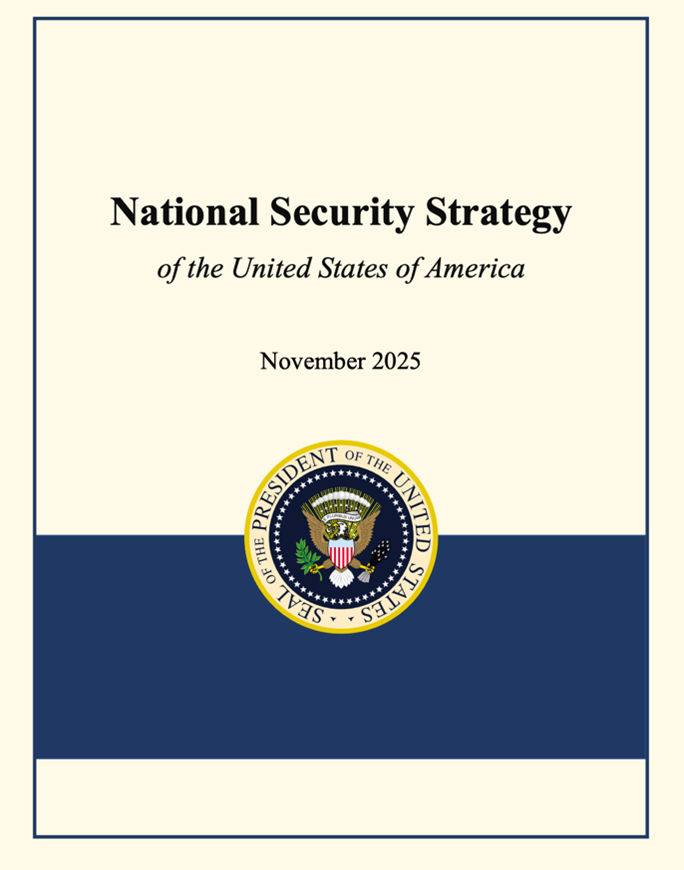
The Trump administration’s National Security Strategy (NSS), released overnight on 4–5 December, offers the most complete articulation yet of what “America First” means in practice. It defines US foreign policy not as an effort to uphold a rules-based system, but as the pursuit of narrowly conceived national interests within a world the document describes as increasingly anarchic and adversarial. The NSS rejects the notion that alliances should be grounded in shared values and instead endorses a doctrine of “flexible realism,” in which partners are instruments for burden-shifting, not pillars of a democratic coalition.
This recalibration is especially visible in the NSS’s regional priorities – and in what it deprioritises. The document announces a return to hemispheric primacy, asserting a new “Trump Corollary” to the Monroe Doctrine. It pledges that the United States will prevent “non-Hemispheric competitors” from acquiring strategic influence in the Americas and warns that Washington may deploy military force against transnational criminal networks and narcotics flows when law-enforcement tools fall short. This reflects a clear intention to harden the southern border, militarise migration management and expand extraterritorial leverage over ports, telecoms and critical-mineral assets across the Caribbean and Latin America.
The Indo-Pacific appears next in the hierarchy. Here the NSS emphasises China as an economic – rather than ideological – challenger. It commits to “rebalancing” the bilateral economic relationship and constraining Beijing’s industrial rise through trade tools, while maintaining a robust forward deterrence posture along the First Island Chain. The US pledges continued opposition to unilateral changes to the Taiwan Strait status quo and calls on regional allies to “spend – and, more importantly, do – much more” to upgrade their militaries, grant access to basing infrastructure and help keep sea lanes open.
Europe, by contrast, is portrayed less as a partner than as a political problem. In language unprecedented for a US national security document, the NSS describes the continent as being at risk of “civilisational erasure” due to migration, low birth rates and “EU overreach,” and accuses European governments of obstructing peace in Ukraine. It warns that portions of NATO could soon be “majority non-European,” undermining transatlantic alignment, and calls for Washington to “cultivate resistance” to Europe’s present trajectory by supporting the rise of “patriotic” Eurosceptic parties. The NSS endorses a rapid ceasefire in Ukraine to “restore strategic stability with Russia” and rejects further NATO enlargement, including for Ukraine – positions welcomed in Moscow.
The Middle East and Africa are tertiary theatres. With US energy “dominance” reasserted and Iran’s nuclear programme “significantly degraded,” the NSS views the region less as a locus for conflict and more as a space for targeted economic plays, security cooperation and arms sales. Africa receives attention primarily through the lens of competition with China, critical-mineral access and counterterrorism. Taken together, the NSS codifies a hierarchical map of US priorities: Western Hemisphere first; Indo-Pacific as the principal economic and deterrence theatre; Europe reframed as a site of ideological contestation; and the Middle East and Africa as secondary arenas for selective engagement. It marks a sharp departure from the post-Cold War US role as the anchor of a liberal order – and signals a more transactional era ahead.
The strategy is not all strategically coherent. It imagines a world in which Europe is passive and the US can unilaterally reorder Eurasia, both false premises. Nor will it be easily implemented. Institutional veto points are already constraining its central aims. Congress is acting as a brake on the administration’s objectives, most notably through the bipartisan National Defense Authorization Act (NDAA) published on 7 December, which, among other constraints, prohibits substantial troop reductions in Europe – hinted at in the NSS – without certification that such moves strengthen US national security.
This makes the NSS less a roadmap and more an expression of political identity – limiting its practical value. But the NSS nonetheless accelerates a reputational shift that the US may struggle to reverse. Allies are learning that American commitments may now vary administration to administration – something traditionally associated with authoritarian states. The mere possibility of US disengagement compels Europe to assume greater defence responsibilities and increases the political cost of relying on Washington. This dynamic will become a permanent feature of Europe’s strategic landscape, shrinking US leverage.
So What?
For companies, the new US strategy matters less for its rhetoric than for what it signals about the underlying world order. It marks a decisive shift away from a rules-based, values-anchored system towards a world organised around spheres of influence, transactional bargains and an increasingly explicit contest between liberal and illiberal governance models.
Nowhere is this clearer than in Europe. The strategy confirms that US foreign policy is no longer centred on leading a bloc of liberal democracies against an “axis of autocrats.” Instead, Washington is aligning more closely with illiberal parties inside allied democracies while soft-pedalling criticism of authoritarian powers such as Russia. The NSS calls for “cultivating resistance” to Europe’s current trajectory and celebrates “patriotic” Eurosceptic parties as partners, even as many EU governments and courts regard them as threats to the rule of law. This reverses decades in which shared democratic norms underpinned Western cohesion and offered a predictable operating environment for business.
Beyond Europe, businesses face a sharper fusion of security and commerce. In the Western Hemisphere, a revitalised Monroe Doctrine implies more extraterritorial pressure on ports, telecoms, energy assets and critical-minerals concessions seen as “hostile foreign” – linked, alongside possible kinetic operations against cartels and a militarised response to migration.

For boards and investors, three practical implications stand out for 2026 and beyond:
First, more volatility and less multilateral shock-absorption: with the US retrenching from multilateralism, disputes over trade, sanctions or migration are now more likely to be resolved through unilateral action and short-term deal-making than through rules-based mechanisms. Companies should expect faster, more personalised swings in policy tied to bilateral relationships and domestic political narratives rather than treaty-anchored predictability.
Second, a tighter, more politicised operating space in Europe: firms face simultaneous pressure to align with EU democratic-governance standards and to navigate US support for parties seeking to erode those standards. This raises the stakes around political-exposure risk, especially in strategic sectors such as defence, tech, data, energy and critical-infrastructure.
Third, a slower, more contested globalisation process: supply chains will increasingly be sorted by bloc; cross-border capital flows will be screened through a governance and security lens; and “neutral” multilateral venues will have less capacity to manage crises. Open markets will persist but with more red lines and carve-outs – particularly around data, dual-use technology, critical minerals and strategic logistics.
The core message for business is straightforward: the 2025 NSS formalises a world in which deals best norms. Companies cannot assume a return to the pre-Trump status quo; they must build strategies, compliance architectures and intelligence functions that treat geopolitical volatility as enduring operating conditions, not temporary noise.
Keen to Know More?
The Audere Group is an intelligence and risk advisory firm offering integrated solutions to companies in complex situations.
We specialise in mitigating the financial, reputational and physical risks faced by our clients in markets across the world through a 360-degree range of services incorporating security advisory, crisis management and strategic intelligence to inform decision making around transactions, supply chains and disputes.
Contact us to learn how our bespoke risk advisory services can work with your unique circumstances to navigate high-risk environments and changing landscapes through the provision of hard-to-reach intelligence and clear analysis.

Disclaimer: The content of this report is for informational purposes only and does not constitute legal or financial advice. For further details or specific inquiries, please reach out to our team directly.