Share
Europe’s Fraying Centre
Welcome to the Audere Atlas, the Audere Group’s fortnightly update on global geopolitical trends, how we engage with them, and what they mean for your organisation.
This week, we examine the far right’s advance in Germany’s autumn regional elections and what it signals for a continent entering a demanding electoral cycle. From Magdeburg to Paris, mainstream incumbents are under pressure, and Russia is working to widen the cracks. For businesses, the result is a Europe where policy is harder to make, harder to predict and more exposed to hostile interference.
The Audere Atlas offers timely, actionable insights that both support key decision-making and highlight areas for further exploration and understanding.
The Bottom Line
Germany’s regional election results point to growing pressure on the country’s political centre, with implications for Chancellor Friedrich Merz’s ability to lead on European priorities. Across Europe, electoral volatility and the changing fortunes of mainstream and nationalist parties are complicating the coalitions needed to sustain defence spending, economic policy,and support for Ukraine. Russia is seeking to exploit these divisions through political relationships and influence operations. For business, the risk is less a sudden rupture than a more contested and unpredictable policy environment, particularly around EU budgets, defence procurement, regulation and economic security.
The Brief
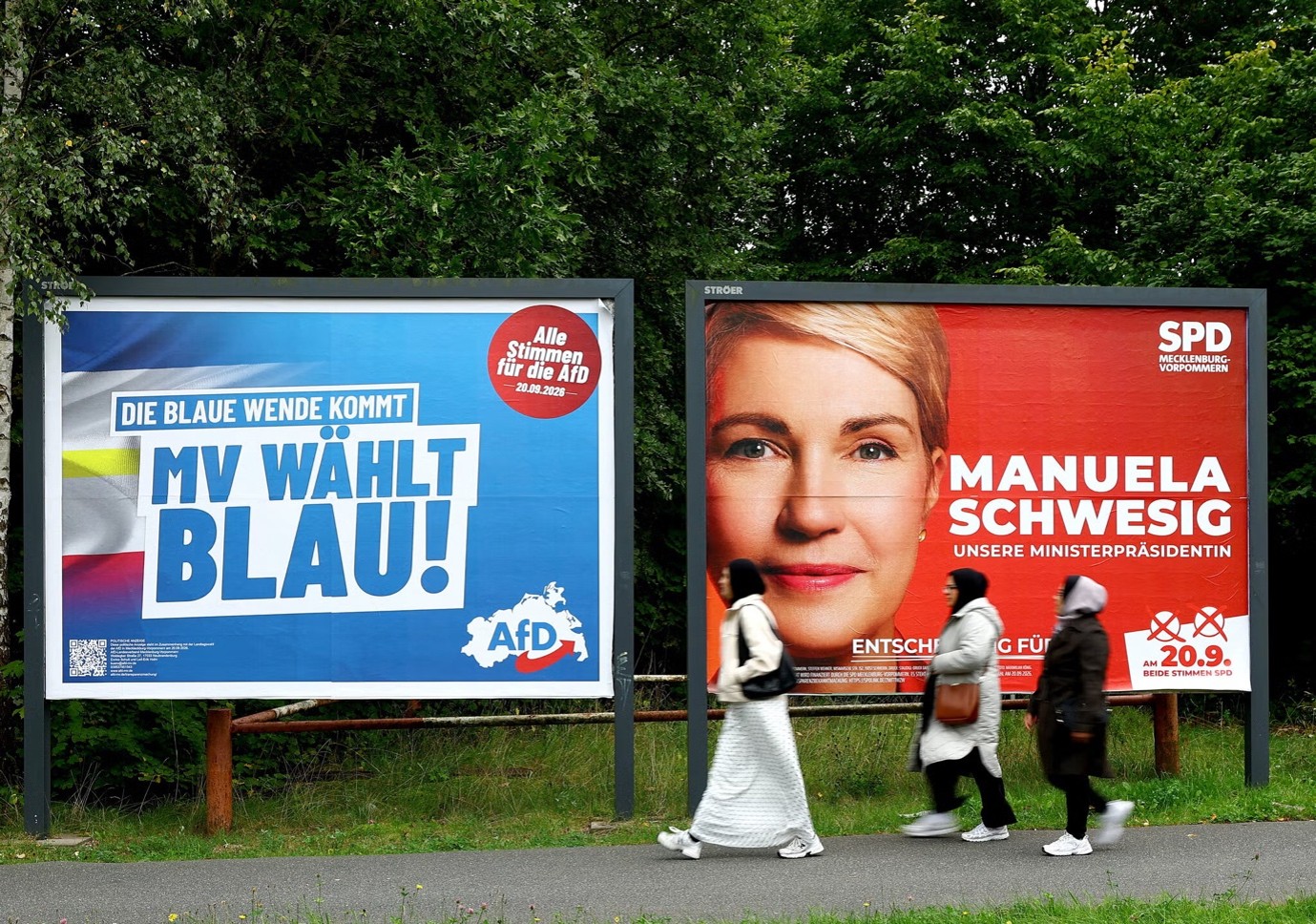
Germany’s autumn state elections have delivered the clearest evidence yet that its political centre is fragmenting. On 6 September, the far-right Alternative für Deutschland (AfD) won 43.8% of the vote in Saxony-Anhalt, falling just short of a governing majority. Two weeks later, it topped the poll in Mecklenburg-Vorpommern with 38.2%, more than doubling its 2021 share. Merz’s Christian Democratic Union (CDU) slumped there to 4.9%, below the threshold for entering the state parliament for the first time in the party’s history. On the same day in Berlin, the hard-left Die Linke came first with 25.7%, pushing the CDU into second place on 18.8%, down from 28.2% in 2023. Nationally, the AfD now leads the CDU by six to seven points.
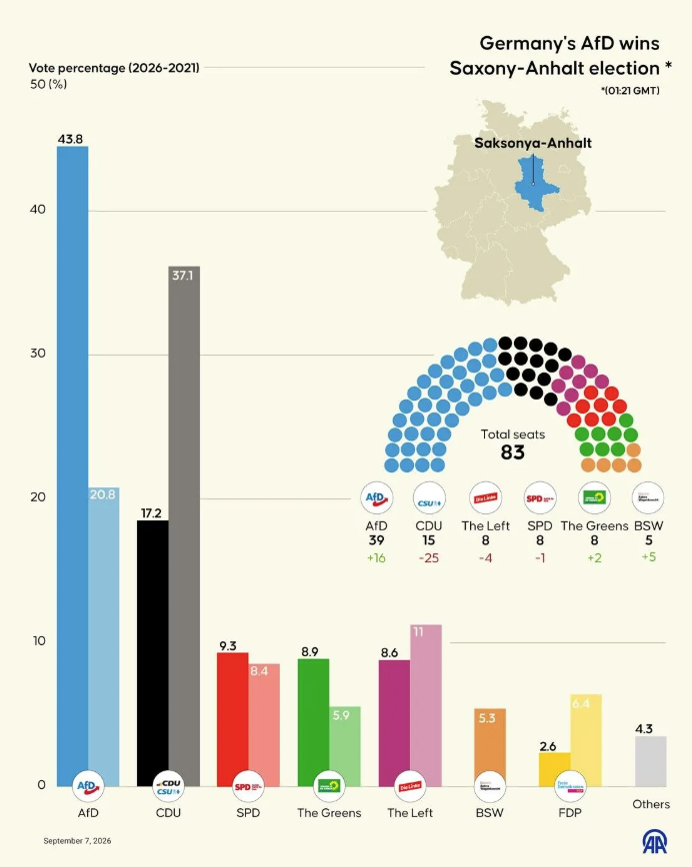
(Figure 1: AfD vote share in Saxony-Anhalt)
Merz called the Mecklenburg-Vorpommern result a “disaster” but has vowed to stay on and push ahead with welfare and economic reforms. Survival is not the same as authority, however, and domestic political pressure could narrow his room for manoeuvre in Brussels. Merz has led a group of fiscally prudent member states pushing for cuts of several hundred billion euros to the European Commission’s proposed €2tn budget for 2028–34. EU officials now doubt that a deal can be struck by the end-of-year target. A weakened chancellor may struggle to broker compromise, while a leadership change would introduce a further period of uncertainty as a successor establishes authority.
The stakes extend beyond the budget. Competition over defence spending, industrial policy, support for Ukraine and economic security is already creating divergent national priorities. Germany’s preference for domestic industry, for example, has provoked a backlash among European partners, raising questions about how increased defence spending can be balanced with collaborative procurement and wider European industrial objectives. Political fragmentation could make these choices more contested, even where the strategic imperative for greater European resilience is broadly shared.
Germany is not alone in facing a challenge to the political centre. France elects a new president on 18 April 2027, with the Rassemblement National’s (RN) Marine Le Pen comfortably ahead in first-round polling. Italy, Spain, Poland and Greece also go to the polls within the next year. Yet the picture is grim rather than uniform. In the UK, a YouGov seat projection this week put Reform UK third, behind Labour and the Conservatives. A year ago, the same pollster had Nigel Farage’s party as the largest in parliament, and two further large-scale polls now point in the same direction. The shift owes less to a collapse in Reform’s vote, which remains close to its rivals’, than to voters’ growing willingness to vote tactically against it. On the continent, Orbán lost power in Hungary this year, the far-right PVV has left the Dutch government, and far-right polling across the EU has plateaued since late 2025. In both Hungary and the Netherlands, other nationalist forces have partly filled the space. The lesson is not that populism is receding, but that its advance is neither linear nor inevitable.
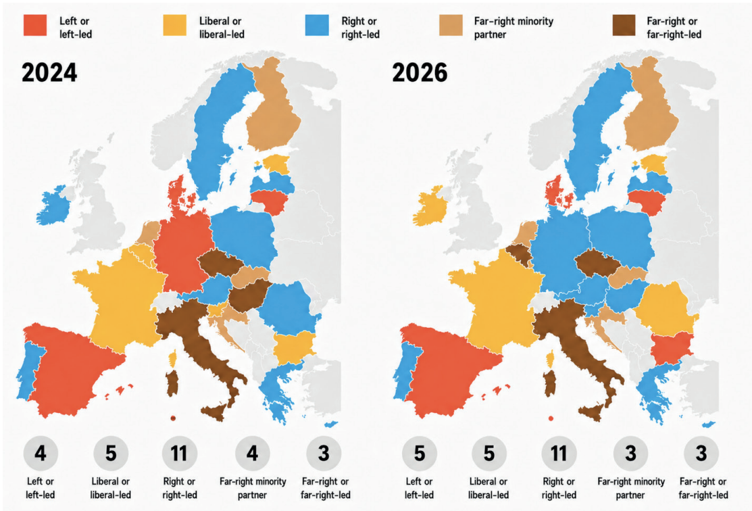
(Figure 2: shift in EU government composition since 2024)
Russia is seeking to widen the cracks. Germany’s domestic intelligence chief has warned that Moscow seeks influence on both political fringes. Both the AfD and the Bündnis Sahra Wagenknecht (BSW) oppose military aid to Ukraine and favour restoring energy ties with Russia. These positions may align with Russian strategic interests, but political alignment should be distinguished from evidence of Russian direction or control. Russian-linked online campaigns have targeted the German state elections. During August’s migrant crisis in the Spanish enclave of Ceuta, Russia-linked accounts pushed far-right narratives to hundreds of thousands of users in seven languages within hours. The episode illustrates how Moscow-linked networks can exploit existing political grievances and amplify divisive narratives. Its significance, however, depends on the strength of the attribution, the actual reach and engagement of the activity, and any demonstrable effect on political behaviour.
This is part of a longer pattern of Russian engagement with European political actors, ranging from political relationships and financing to influence operations. Earlier examples include Lega’s 2017 cooperation agreement with Putin’s United Russia party, the RN’s loan from a Russian bank, and the 2019 Ibiza scandal that brought down Austria’s vice chancellor. These cases illustrate different forms of engagement rather than a single model of control. Moscow’s objectives may include weakening support for Ukraine and European defence, increasing the political cost of alignment with Western policy, and exploiting dissatisfaction with mainstream parties. Its ability to translate these efforts into policy influence varies by country and political context.
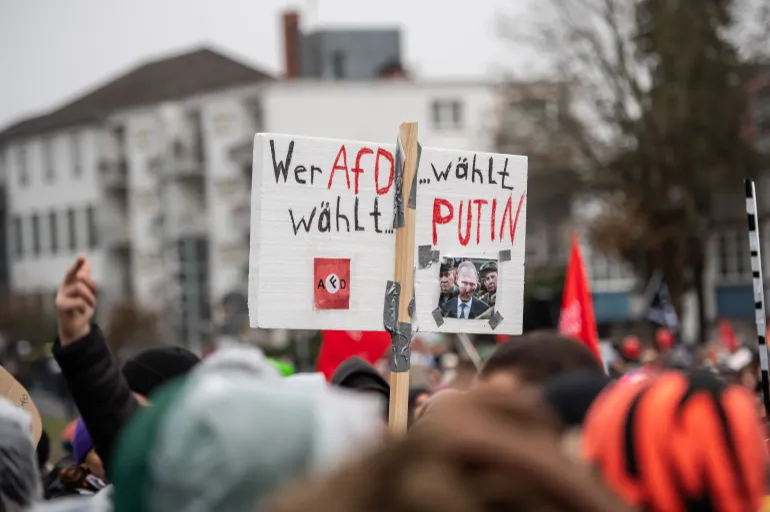
(Figure 3: An anti-AfD protest highlights the party’s Russia ties)
So What?
The immediate consequence is a Germany less able to lead at the moment Europe needs it to. Berlin has traditionally brokered compromise in Brussels, and a weakened chancellor cannot. Businesses that depend on EU funding streams, from agriculture and cohesion to defence and competitiveness, should expect the 2028–34 budget to slip. There is a real risk that negotiations collide with a possible RN victory in France next spring. EU action on Chinese trade pressure, the easing of climate rules,and financing for Ukraine could be delayed in the same way.
Defence remains a bright spot, but a shifting one. Germany will reshape rather than cut its spending. Research from the International Institute of Strategic Studies (IISS) shows European allies are on course to spend around $638 billion on defence this year, with close to two-thirds of recent procurement contract value going to European suppliers. Yet Berlin’s preference for German industry is provoking a backlash among partners, and some rebalancing towards collaborative programmes is likely. But a far-right state government would test Germany’s security assumptions. Berlin is reportedly preparing to restrict the AfD-led Saxony-Anhalt’s access to classified material, including the Bundeswehr’s plan for responding to a Russian attack. Allies such as Poland have privately raised concerns about intelligence sharing, and the AfD may challenge such moves in court. Companies holding public-sector contracts, security clearances or data-sharing obligations in AfD-governed regions should anticipate friction between state and federal authorities.
Geoeconomic policy will be shaped by the interaction between electoral pressure and European strategic priorities. The EU’s response to Chinese trade pressure, the easing of climate rules, financing for Ukraine, and the future allocation of defence investment all involve competing national and political interests. A more fragmented political environment could make agreement harder to sustain, especially where measures impose concentrated costs on particular sectors or constituencies. The implications will vary by country and policy area: electoral pressure may constrain some governments while creating space for others to pursue more assertive industrial or security policies. Businesses should therefore track national political trajectories alongside EU-level decisions, rather than assuming a uniform European response.
Audere Group can help clients navigate this environment:
• Our political risk monitoring and scenario planning track electoral and coalition dynamics across Germany, France, the UK and beyond, and translate them into operational decisions.
• Enhanced due diligence identifies politically exposed persons and Russian-linked intermediaries among counterparties, partners and suppliers.
• For defence and critical infrastructure operators, our security risk management and crisis-planning services prepare for sabotage and hybrid disruption.
• Our investigations team can trace the origins of disinformation targeting a firm’s reputation.
Europe’s political centre remains capable of sustaining government and policy continuity, but uneven electoral pressure is making that task more contested. Businesses that operate across the continent will need to account for differences in national political trajectories, coalition dynamics and exposure to European policy changes. Political fragmentation should be treated as an operating condition to monitor, not a uniform or inevitable path towards institutional paralysis.
Keen to Know More?
The Audere Group is an intelligence and risk advisory firm offering integrated solutions to companies in complex situations.
We specialise in mitigating the financial, reputational and physical risks faced by our clients in markets across the world through a 360-degree range of services incorporating security advisory, crisis management and strategic intelligence to inform decision making around transactions, supply chains and disputes.
Contact us to learn how our bespoke risk advisory services can work with your unique circumstances to navigate high-risk environments and changing landscapes through the provision of hard-to-reach intelligence and clear analysis.
Disclaimer: The content of this report is for informational purposes only and does not constitute legal or financial advice. For further details or specific inquiries, please reach out to our team directly.