Share
AI Sovereignty, Not Autarky
Welcome to the Audere Atlas, the Audere Group’s fortnightly update on global geopolitical trends, how we engage with them, and what they mean for your organisation.
This week, we examine what the accelerating US-China AI competition means for UK sovereign capability. Washington and Beijing are increasingly using industrial policy, trade restrictions and investment to shape the technologies on which AI depends. Yet the resulting ecosystem is unlikely to divide neatly into two camps. For Britain, the challenge is therefore not to recreate an entirely domestic AI industry, but to determine where foreign dependence creates unacceptable strategic exposure – and whether the UK has the industrial and institutional capacity to manage it.
The Audere Atlas offers timely, actionable insights that both support key decision-making and highlight areas for further exploration and understanding.
The Bottom Line
The immediate risk of renewed US-Iran escalation has eased after President Trump postponed planned strikes to allow further negotiations. But the conflict has permanently altered the strategic environment for Gulf energy infrastructure. Iran has demonstrated both the willingness and the capability to strike energy, transport and commercial infrastructure across the region, establishing these assets as enduring instruments of coercion in both war and diplomacy.
The Brief
The US–China AI competition is moving beyond the race to develop the most capable models and chips. Washington and Beijing are increasingly seeking influence over the infrastructure, software and supply chains needed to develop and deploy AI. Yet their different strengths make a clean technological split unlikely. The US retains an advantage in frontier computing and models, while China has major strengths in manufacturing scale, cost and parts of the physical infrastructure required to deploy AI.
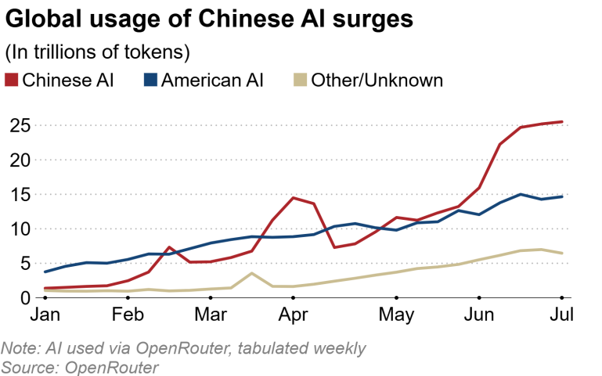
This points towards selective separation rather than two independent ecosystems. Advanced computing is the clearest dividing line: US restrictions have limited China’s access to leading-edge processors and manufacturing equipment while encouraging Beijing to accelerate domestic alternatives. Similar security concerns are extending into data-centre equipment, power systems and robotics. Software is harder to separate. Chinese open-weight models are becoming more capable and substantially cheaper than many proprietary alternatives, giving companies strong incentives to use them where security concerns are manageable.
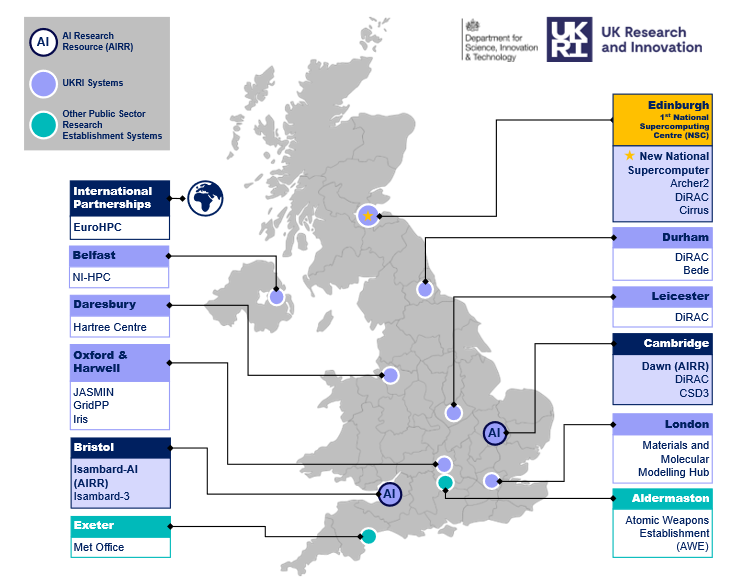
For countries navigating this competition, like the UK, the implication is not that they should attempt to replicate either ecosystem. Britain has important strengths in AI research and a growing technology sector, but clearly lacks the scale to build competitive capacity across the entire chain, from advanced semiconductor production to frontier models and hyperscale computing. The more useful objective is assured access to the capabilities that matter most. Advanced compute, sensitive government data, military AI and critical digital infrastructure are likely to warrant domestic capacity or sufficiently trusted alternatives; elsewhere, international competition can continue to determine procurement.
The UK is beginning to use government policy to support this approach. The £500mn Sovereign AI initiative, including a new £100mn procurement programme for British start-ups, aims to develop domestic capability in areas including public-sector AI, computing capacity, defence and cyber security. Its significance lies not only in the funding but in the use of government procurement to provide early customers for companies that may otherwise struggle to scale. The political sensitivity of relying on foreign technology has also been illustrated by controversy over major public-sector contracts with US technology companies.
Domestic capability, however, depends on more than domestic companies. The government’s decision to redistribute the responsibilities of the Department for Science, Innovation and Technology across other departments has raised concerns about disruption and the loss of dedicated expertise, although the government argues that a Cabinet-level AI minister and new AI Taskforce will give technology policy greater influence at the centre. The important question is whether the new structure can coordinate the policy areas that determine whether AI capability can scale – including energy, planning, data, regulation, skills and procurement.
There is also a risk in relying too heavily on the US. American technology will remain indispensable to Britain in many areas, but dependence on US providers creates exposure to Washington’s export-control and technology policies. It creates economic exposure too. AI investment now accounts for an unusually large share of US investment and growth, meaning a sharp reduction in hyperscaler spending could affect global demand for chips, data centres, energy and associated infrastructure. A correction would not imply that AI had failed; it would more likely represent a pause within a longer investment cycle. But it could expose economies and companies that have become dependent on continued US investment.
The UK therefore needs to preserve choice rather than pursue autarky. That means developing domestic strengths where external dependence would create unacceptable risk, maintaining access to international technology and ensuring sufficient supplier diversity and institutional capacity to absorb geopolitical or economic shocks. For businesses, this makes AI procurement a geopolitical consideration: understanding where models and computing infrastructure originate, where data is processed, which jurisdictions govern suppliers and how readily providers can be replaced will increasingly form part of technology-risk management.
So What?
The UK does not need to win the AI race. It needs to retain the ability to participate in it on its own terms. That means building domestic strengths where dependence would create unacceptable risk, maintaining access to international technology and ensuring that government has the institutional capacity to turn those resources into usable capability.
But for businesses, AI procurement is becoming a geopolitical decision. Companies will increasingly need to know where their models and computing infrastructure originate, where data is processed, which jurisdictions govern suppliers and how readily they could switch providers. Building that optionality before a restriction or disruption occurs will be considerably cheaper than doing so afterwards.
The emerging landscape also creates opportunities for UK and European firms. Greater demand for trusted computing, secure data environments, cybersecurity and AI-enabled defence capabilities should create markets for companies able to offer alternatives to strategically exposed suppliers. The wider European drive towards technological and defence autonomy will reinforce this demand.
Audere Group can support organisations navigating this increasingly politicised technology environment. Our strategic advisory capabilities can assess exposure to US–China technology competition, map dependencies across AI and wider digital supply chains, and evaluate the implications of export controls, regulation and shifts in technology investment. Enhanced due diligence can provide greater visibility over technology partners and suppliers, while geopolitical monitoring can identify emerging policy changes before they become operational problems. For organisations exposed to critical technology or infrastructure, Audere can also identify vulnerabilities, assess alternative suppliers and develop strategies to strengthen resilience.
As AI becomes a strategic asset as well as a commercial technology, understanding where technological dependence creates vulnerability will become central to both corporate and national decision-making.
een to Know More?
The Audere Group is an intelligence and risk advisory firm offering integrated solutions to companies in complex situations.
We specialise in mitigating the financial, reputational and physical risks faced by our clients in markets across the world through a 360-degree range of services incorporating security advisory, crisis management and strategic intelligence to inform decision making around transactions, supply chains and disputes.
Contact us to learn how our bespoke risk advisory services can work with your unique circumstances to navigate high-risk environments and changing landscapes through the provision of hard-to-reach intelligence and clear analysis.

Disclaimer: The content of this report is for informational purposes only and does not constitute legal or financial advice. For further details or specific inquiries, please reach out to our team directly.