Share
The Houthis Find Riyadh’s Weak Point
Welcome to the Audere Atlas, the Audere Group’s fortnightly update on global geopolitical trends, how we engage with them, and what they mean for your organisation.
This week, we examine Yemen’s Houthis, who have reopened their war with Saudi Arabia and are now striking the infrastructure the kingdom relies on to bypass the closed Strait of Hormuz. Their growing self-sufficiency, built partly on components bought on international markets, also raises a hard question for companies: how far does their supply-chain screening really reach?
The Audere Atlas offers timely, actionable insights that both support key decision-making and highlight areas for further exploration and understanding.
The Bottom Line
The Houthis have turned Saudi Arabia’s escape route from the closed Strait of Hormuz into leverage of their own. By striking the East-West pipeline, Red Sea terminals, Riyadh’s airport and Aramco’s headquarters while tightening their grip on Bab al-Mandab, they have shown they should not be underestimated. Increasingly self-sufficient, they have outlasted every adversary since 2004. For business, the exposure runs from Gulf assets and Red Sea shipping to international supply chains whose dual-use components have ended up in Houthi missiles.
The Brief
The Houthis have a gift for finding the pressure point. In 2024 and 2025 they held Red Sea shipping to ransom in the name of Gaza, launching an estimated 530 attacks on vessels and cutting traffic through Bab al-Mandab to below a third of pre-war levels. It has never recovered. When the US–Israel war on Iran began in February, the Houthis stayed out, rebuilding their capabilities while Saudi Arabia hoped to sit out the conflict. They were waiting for their opening, which came with Riyadh’s reliance on the route it built to escape the closed Strait of Hormuz: the 1,200 km East-West pipeline from Abqaiq to Yanbu on the Red Sea, where shipments rose from about 1 million to 4.9 million barrels per day during the conflict.
The 2022 truce, which had halted seven years of war between the Houthis and the Saudi-led coalition, collapsed in July. On 13 July a strike hit the runway at Sana’a airport to stop an Iranian plane returning a Houthi delegation from the funeral of Iran’s slain Supreme Leader, Ali Khamenei. On 20 July the Houthis declared a retaliatory blockade of Saudi ports and shipping, and within days had targeted Saudi-linked tankers and Aramco facilities at Yanbu and Jazan. They have since attacked at least 12 commercial vessels with drones, cruise and ballistic missiles. On land, a lightning offensive against Saudi-backed forces won them the port of Mokha and Perim Island on 10–11 September, giving them a physical hold on Bab al-Mandab.They are now encircling the strategic city of Taiz. If government forces lose there, Riyadh will have no credible partner on the ground.
October brought the campaign to the heart of the kingdom. Strikes on Riyadh’s King Khalid International Airport have killed at least 14 people and closed it for days, prompting several foreign airlines to suspend flights. The 10 October strike alone killed 13, the most civilian casualties of any attack on a Gulf state since February. On 13 October a missile hit an Aramco building in Dhahran, on the Gulf coast at the far side of the kingdom.
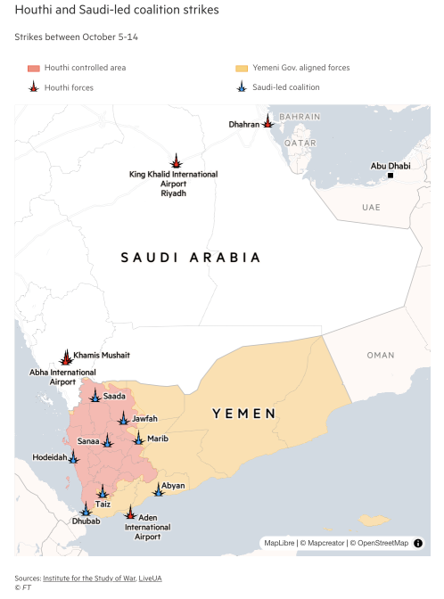
Figure 1: Houthi and Saudi strikes in early October. Source: Financial Times
Saudi air defences have intercepted many Houthi missiles and drones, but not enough to stop them, and every interception costs far more than the weapon it destroys. Riyadh now faces threats on three fronts: Iran to the east, Iran-backed Iraqi militias to the north and the Houthis to the south. Gulf states have fired hundreds of their most advanced interceptors against Iran since February, and much of what they have ordered to replace them will not arrive until 2027–28. The US has fast-tracked a $2bn precision-weapons sale, but CNN reported in August that it had used about half its Patriot interceptors and nearly 80% of its THAAD stock since February. Without the US, Saudi Arabia and the rest of the Gulf must rely on piecemeal support from a range of European and regional partners.
By contrast, the Houthi arsenal is increasingly home-built. Conflict Armament Research reported on 14 October that the group sought Chinese-sourced fin cores, rocket-motor igniters and heat-shield resin to assemble a version of Iran’s Kheibar Shekan missile, alongside industrial machinery for production and testing. In one 2025 seizure, only about 5% of documented components were Iranian-made. The Houthis still rely on Iranian technology and intelligence, but they make their own decisions, and with Hizbollah weakened they see themselves as the region’s leading resistance force. They have outlasted six wars with Yemen’s government, seven years of Saudi-led intervention, US and UK strikes, and an Israeli campaign that killed their prime minister in 2025.
So What?
The Houthis’ campaign is a study in leverage. They will use whatever pressure point is available, and they choose it themselves. In April 2025, the Audere Atlas warned that conflict with Iran would bring retaliation “via regional proxies, cyberattacks, and missile strikes on Gulf infrastructure”. That risk has arrived, but from a group that is not taking orders. Their demands are concrete: an end to the Saudi blockade of the ports and airports they control, money, and de facto recognition of their victory in Yemen. A settlement between Washington and Tehran would not, on its own, end the threat.
For organisations with people or assets in Saudi Arabia, almost the entire kingdom is now in range, and the range will grow as domestic missile production matures. The Houthis have issued evacuation warnings for Aramco sites and Riyadh’s airport before striking them, a sign of confidence in their ability to hit. Flight suspensions, event cancellations and sudden closures of transport hubs, all seen in the past fortnight, should be treated as planning assumptions. The Red Sea coast is especially exposed: Jeddah, its resorts and the tourism projects at the centre of Vision 2030 all sit within easy reach.
At sea, the Houthis say they target only Saudi-linked ships, but they decide what counts as a link and have struck vessels with no Saudi connection before. Bab al-Mandab matters less for oil than for container trade between Asia, Europe and North Africa, so the exposure reaches well beyond energy. Shipowners, charterers and cargo interests should review their exposure through cargo origin, counterparties and ports of call, and budget for higher war-risk premiums and longer routes. If the US–Iran war reignites, both chokepoints could be disrupted at once.
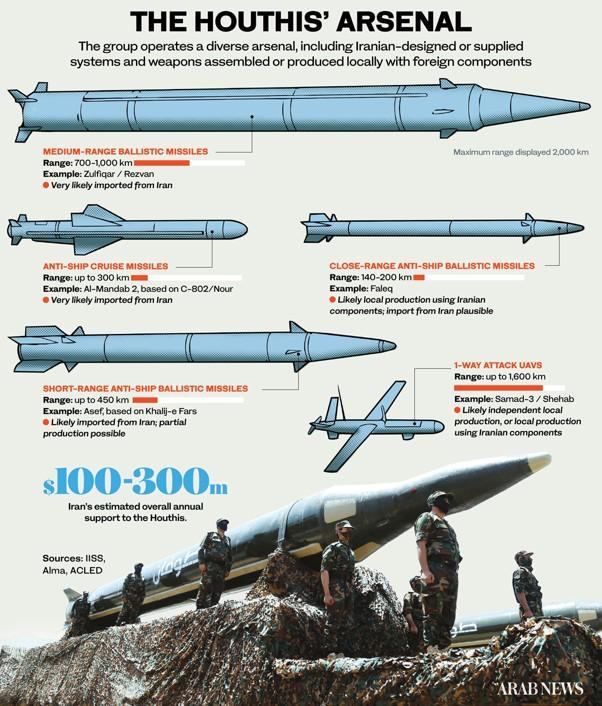
Figure 2: The Houthi Arsenal, Source: Arab News
The less visible exposure lies in supply chains. The Houthi arsenal is assembled from commercial goods: precision-machined metal parts, small engines, navigation sensors, servo-actuators and industrial machinery. Many of these items are not export-controlled. According to Wolf-Christian Paes of the IISS, a former member of the UN Panel of Experts on Yemen, the Houthis now source “basically almost everything they need” from China, including European components re-exported from there. Goods typically pass through distributors in Hong Kong and southern China, trading companies in third countries, free zones and dhow networks before they reach Hodeidah. Few companies can see that far: screening that stops at the direct customer misses every step after it. With the Houthis designated a Foreign Terrorist Organization by the United States since March 2025, the consequences of being found in that chain are legal as well as reputational.
Audere Group can help clients navigate this environment:
• Security risk management and travel risk management provide threat assessment, journey management, contingency planning, crisis management support and evacuations for teams in the region.
• Supply chain fraud investigations and ongoing monitoring trace where products travel beyond the direct customer, with covert operations where conventional methods fall short.
• Enhanced due diligence, including beneficial ownership verification, sanctions screening and link analysis, identifies distributors, agents and intermediaries connected to sanctioned parties or procurement networks.
• Our geopolitical and country analysis, including security and defence analysis and scenario planning, tracks the Houthi campaign and translates it into decisions on assets, staff and shipping in Saudi Arabia and the Red Sea.
The Houthis have shown, from the Red Sea in 2024 to Saudi Arabia’s pipelines today, that they will exploit any leverage they can find. Organisations that understand where they sit within the Houthis’ leverage, whether as asset owners, shippers or suppliers, will be best placed to manage it.
Keen to Know More?
The Audere Group is an intelligence and risk advisory firm offering integrated solutions to companies in complex situations.
We specialise in mitigating the financial, reputational and physical risks faced by our clients in markets across the world through a 360-degree range of services incorporating security advisory, crisis management and strategic intelligence to inform decision making around transactions, supply chains and disputes.
Contact us to learn how our bespoke risk advisory services can work with your unique circumstances to navigate high-risk environments and changing landscapes through the provision of hard-to-reach intelligence and clear analysis.

Disclaimer: The content of this report is for informational purposes only and does not constitute legal or financial advice. For further details or specific inquiries, please reach out to our team directly.