Share
The Donroe Doctrine & Hemispheric Politics
Welcome to the Audere Atlas, the Audere Group’s fortnightly update on global geopolitical trends, how we engage with them, and what they mean for your organisation.
This edition assesses how the emergence of the so-called “Donroe Doctrine” is reshaping US strategy, signalling a move toward direct power projection and hemispheric dominance, and considers the implications for corporate decision-making in an increasingly coercive geopolitical environment.
The Audere Atlas offers timely, actionable insights that both support key decision-making and highlight areas for further exploration and understanding.
The Bottom Line
The “Donroe Doctrine” marks Washington’s shift from rules-based partnership to direct strategic control across the Western Hemisphere. The seizure of Nicolás Maduro signalled a structural break: coercive tools are now used openly to shape political outcomes and market dynamics across the region.For corporates, this shift in geostrategic intent creates both short- and long-term risks, particularly for those exposed to the emerging fault lines of Trump’s doctrine.
The Brief
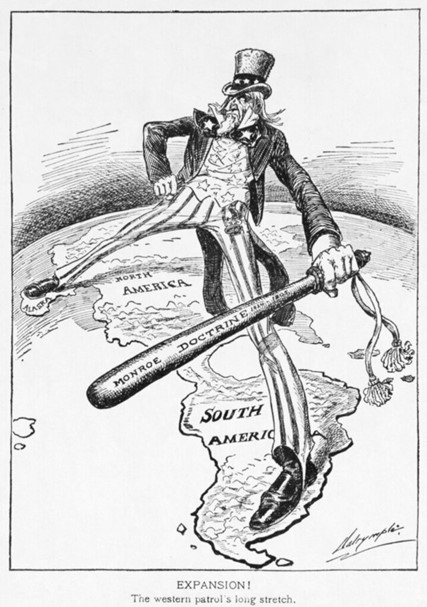
For much of the twentieth century, the Monroe Doctrine defined Washington’s hemispheric intent: excluding extra-regional powers from the Americas by anchoring US influence close to home. That principle evolved, through the Roosevelt Corollary, which asserted a US right to intervene in Latin American states deemed unstable, and later through Cold War security strategies that prioritised containment, proxy influence and alliance management over direct territorial control.
With the end of the Cold War, this framework largely atrophied. But the Trump administration’s 2025 National Security Strategy revived it by formalising a new Trump Corollary to Monroe, asserting that the United States would “reassert and enforce the Monroe Doctrine” by denying non-hemispheric competitors strategic access and prioritising US pre-eminence in the Western Hemisphere.
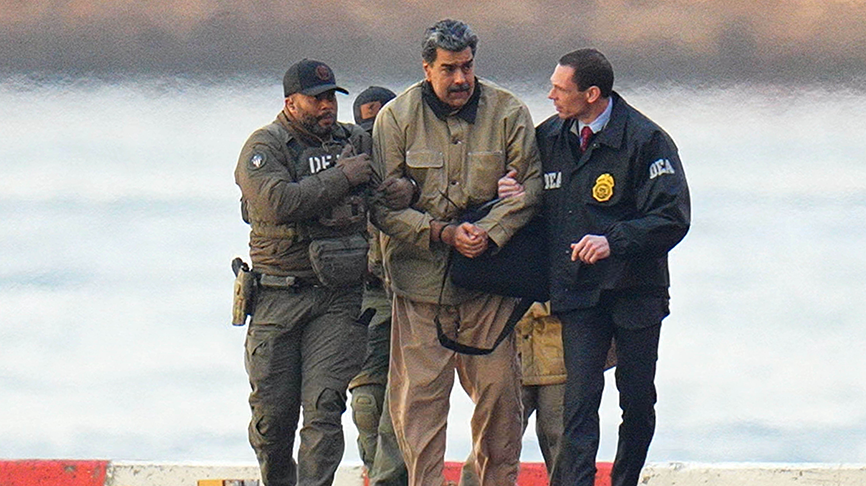
In early 2026, a US military operation in Venezuela seized President Nicolás Maduro, signalling a willingness to apply coercive force under this expanded doctrine. The operation was not designed as regime-building, but as demonstration: that the United States is prepared to act decisively within its perceived sphere of influence, with speed, force and limited regard for international constraint.
The Donroe Doctrine reflects a strongman conception of power in which dominance, rather than legitimacy, is seen as the basis of stability. This logic has been articulated most clearly by Stephen Miller, US Homeland Security Advisor and a central figure in Trump’s inner circle, who has argued that international politics is “governed by strength … by force … by power,” dismissing international law and diplomacy as “international niceties.” Trump’s repeated assertions that his authority is constrained primarily by his “own morality”, alongside explicit threats to acquire Greenland (an allied territory) demonstrate a willingness to test legal, political and alliance boundaries simultaneously.
Venezuela was therefore not an isolated case, but a proof-of-concept: hemispheric dominance, rapid coercion and legal ambiguity are now core features of US statecraft.
There is little evidence that such actions materially alter Beijing’s calculus on Taiwan or Moscow’s approach to Ukraine; both are driven by power, opportunity and internal assessments rather than precedent or international norms. More troubling, however, is that the United Statesnow appears increasingly unconstrained by the very norms it once helped to shape.
The muted response from Europe and other Western allies to the Venezuela raid suggests limited resistance to this more coercive order and points to the return of spheres-of-influence thinking. As Garry Kasparov put it: “If you don’t have a sphere of influence, then you will be in a sphere of influence.”
So What?
The Donroe Doctrine is underpinned by a hard geoeconomic reality: the United States now sits at the centre of a de facto hemispheric oil empire. Taken together, US, Canadian and Latin American production accounts for close to 40% of global oil output, giving Washington an unprecedented ability to shape supply, prices and market access. By pulling these barrels under a single security and political umbrella – whether through direct control, influence or alignment – the US has sharply reduced its historic vulnerability to energy shocks and gained new leverage over both allies and adversaries.
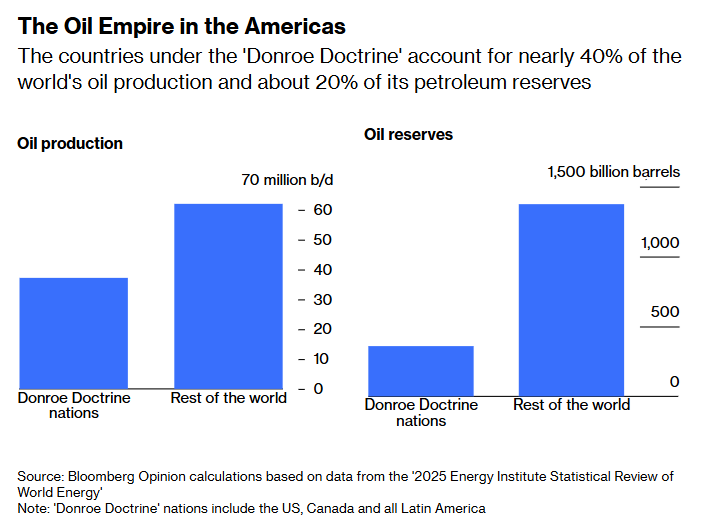
[Credit: Bloomberg]
For corporates, this reinforces the centrality of US political alignment in energy strategy: access to capital, licences and markets will increasingly be conditioned not just on commercial logic, but on compliance with a US-defined geopolitical order.
In theory, political realignments across the hemisphere could unlock new supply flows and market access. But a world in which power is exercised without legal justification is not only more violent but materially less investable. The post-1945 international order rested on a simple constraint: force could be used only with legal cause, creating predictability even when rules were bent or violated. The Trump administration’s open rejection of that constraint marks a shift from rule-breaking to rule denial.
Regardless of the administration’s indifference to international law, corporates cannot share that posture. Assets in jurisdictions subject to coercive control – such as Venezuela, or a post-US takeover Greenland – will be viewed as legally ambiguous and exposed to future prosecution, expropriation claims and successor-government challenge. This helps explain the caution of US oil majors in Venezuela: the risk is not volatility, but legal nihilism.
The deeper risk for business lies in continued US probing. The administration is actively testing how far norms, laws and alliances can be stretched with each high-profile action. Flashpoints such as Greenland or the Panama canal sit within the same hemispheric-dominance logic as Latin America, raising the prospect of friction not just with adversaries but with allies. This leaves assets in the Western hemisphere at greater risk of interference. Trump’s messaging should therefore be treated as a leading indicator: shifts in tone, asset-focused language and public narrative often precede concrete action. And where US action is concerned in the new reality of the Donroe doctrine, nothing can be considered off the table.
Audere helps organisations navigate this environment by translating geopolitical power shifts into operational and investment decisions. We support boards and investment committees with political risk analysis, sanctions and legal exposure mapping, and asset-level due diligence. Where uncertainty is highest, we provide discreet intelligence on stakeholder dynamics and regulatory risk – allowing clients to preserve optionality, protect value and act with clarity in a period of sustained geopolitical volatility.
Keen to Know More?
The Audere Group is an intelligence and risk advisory firm offering integrated solutions to companies in complex situations.
We specialise in mitigating the financial, reputational and physical risks faced by our clients in markets across the world through a 360-degree range of services incorporating security advisory, crisis management and strategic intelligence to inform decision making around transactions, supply chains and disputes.
Contact us to learn how our bespoke risk advisory services can work with your unique circumstances to navigate high-risk environments and changing landscapes through the provision of hard-to-reach intelligence and clear analysis.
Disclaimer: The content of this report is for informational purposes only and does not constitute legal or financial advice. For further details or specific inquiries, please reach out to our team directly.