Share
How the US-Iran Conflict Has Permanently Changed the Risk to Gulf Infrastructure
Welcome to the Audere Atlas, the Audere Group’s fortnightly update on global geopolitical trends, how we engage with them, and what they mean for your organisation.
This week, we examine the latest phase of the US-Iran conflict and why it represents a lasting shift in the strategic environment for Gulf energy infrastructure. While diplomacy has once again reduced the immediate prospect of major escalation, the conflict has demonstrated that critical civilian infrastructure is now a central instrument of coercion. Regardless of whether negotiations succeed or fail, there is no going back to the pre-war status quo.
The Audere Atlas offers timely, actionable insights that both support key decision-making and highlight areas for further exploration and understanding.
The Bottom Line
The immediate risk of renewed US-Iran escalation has eased after President Trump postponed planned strikes to allow further negotiations. But the conflict has permanently altered the strategic environment for Gulf energy infrastructure. Iran has demonstrated both the willingness and the capability to strike energy, transport and commercial infrastructure across the region, establishing these assets as enduring instruments of coercion in both war and diplomacy.
The Brief
President Trump’s decision over the weekend to suspend planned strikes against Iran has revived hopes that negotiations may yet produce a broader settlement. According to Trump, Gulf partners urged Washington to allow diplomacy to continue after agreement was reached on the broad parameters of a deal, centred on reopening the Strait of Hormuz and addressing Iran’s nuclear programme. Similar optimism has proved premature before, however, and the US military remains, in Trump’s words, “locked and loaded”. The Memorandum of Understanding agreed in June has been effectively zombified, leaving the current pause highly contingent on continued diplomatic progress.
More importantly, the conflict has already evolved beyond the framework the MoU sought to contain. Rather than remaining principally a bilateral confrontation between Washington and Tehran, it has gradually drawn in a widening range of regional actors. Bahrain and Kuwait have conducted offensive operations against Iran in their own national capacities, Saudi Arabia has acknowledged strikes against Iranian-backed militias in Iraq in retaliation for Iraqi militia attacks on Saudi infrastructure, and the Houthis have intensified attacks against Saudi shipping and energy infrastructure, extending pressure from the Strait of Hormuz into the Red Sea and, more recently, towards shipping associated with the Suez Canal. In this context, despite ongoing negotiations, the risk of escalation remains acute. That is particularly worrying given the centrality that economic assets, in particularly energy and other critical infrastructure, have taken as an arena for the conflict.
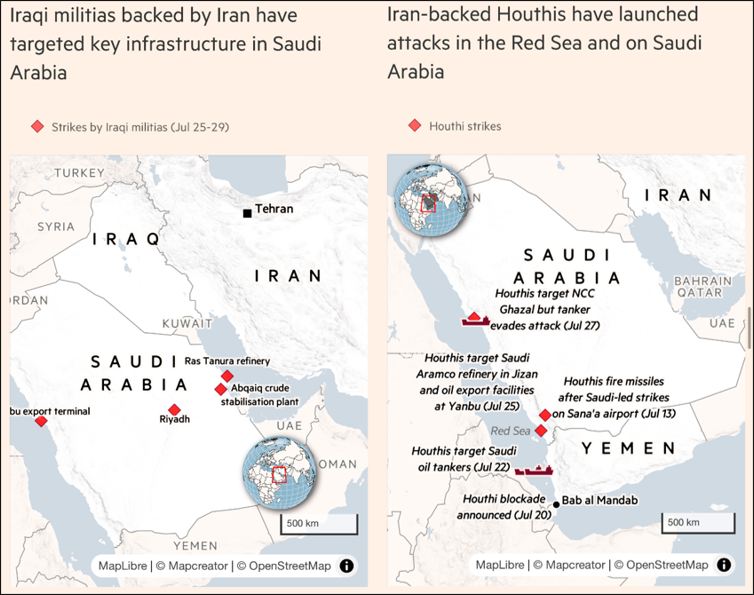
Image: Iranian partners’ strikes on Gulf assets in July. Source: FT
Rather than seeking outright military victory, Tehran has sought to shape the pace, geography and economic costs of the war. Critical infrastructure has been central to that approach from the outset, allowing Iran to widen the number of actors exposed to the conflict while placing pressure on regional energy markets, commercial shipping and Gulf economies.
Iran’s campaign against Gulf infrastructure has therefore been neither incidental nor reserved for moments of major escalation. Since the conflict began in February, attacks against civilian infrastructure have formed a consistent component of Tehran’s military approach. According to ACLED, Iran and aligned groups have conducted more than 170 attacks against non-military infrastructure across the Gulf. Almost half targeted energy facilities—including oil installations, gas infrastructure, power stations and desalination plants—while airports, ports and other commercial infrastructure accounted for most of the remainder. More than 70% caused material damage, demonstrating both Iranian intent and an increasing ability to penetrate regional air defences.
Image: Recorded attacks on Gulf infrastructure since the conflict began. Source: ACLED
Equally significant is how early this campaign emerged. Iran escalated against Gulf energy infrastructure far sooner than many observers expected and has continued to do so despite repeated diplomatic initiatives and intermittent pauses in fighting. Recent attacks against Saudi Aramco facilities, Red Sea shipping and associated infrastructure suggest Tehran no longer treats critical infrastructure as an exceptional target reserved for existential moments. Instead, it has become a routine instrument of coercion, used to shape negotiations as much as military operations.
That has implications regardless of how the current diplomacy unfolds. Even if negotiations ultimately succeed, Iran has demonstrated both the doctrine and the capability to hold Gulf infrastructure at risk. A future agreement may reduce the frequency of attacks, but it is unlikely to restore the previous assumption that regional energy infrastructure sits outside the principal arena of strategic competition.
Should negotiations fail, the implications become more severe still. Iran has already shown that energy infrastructure will remain a primary pressure point throughout any renewed conflict. Washington, meanwhile, has reportedly struck around 80% of the military target set identified at the outset of the campaign, leaving relatively few conventional military objectives untouched. Any renewed US offensive would therefore be increasingly likely to expand against Iran’s remaining nuclear, command and critical infrastructure. The next phase of the conflict would consequently be characterised less by conventional force-on-force operations than by reciprocal attacks on the infrastructure underpinning regional economies.
So What?
For businesses, the principal implication is not that Gulf energy exports become impossible. Rather, infrastructure previously regarded as strategically resilient must now be assessed as persistently contestable.

Image: Map of Gulf infrastructure targeted by Iran. Source: ACLED
The conflict has demonstrated that oil and gas facilities, export terminals, ports, airports, electricity generation, desalination plants, logistics hubs and digital infrastructure are all capable of generating strategic leverage. Even limited attacks can interrupt commercial activity, increase insurance premiums, raise shipping costs and undermine investor confidence without causing prolonged interruptions to production itself. The commercial consequences therefore extend well beyond energy markets.
Equally important, this represents a structural rather than temporary change in risk. Iran has shown that attacks on critical infrastructure are an effective means of exerting pressure on both Gulf governments and the United States, while exposing the practical limits of even sophisticated regional air-defence systems. Future periods of regional tension—whether linked to the current conflict or not—are therefore more likely to feature infrastructure attacks than before February 2026.
The precedent may extend beyond the Gulf. By demonstrating that repeated attacks on energy, transport and commercial infrastructure can impose strategic costs without requiring conventional military success, the conflict has provided a potential blueprint for other state and non-state actors. Similar tactics could be used elsewhere to exploit concentrated infrastructure, stretch air defences and generate economic disruption while remaining below the threshold of full-scale war.
Businesses should accordingly assess Middle Eastern exposure at the level of interconnected infrastructure networks rather than individual assets. Energy production, maritime trade, electricity, water, transport and digital connectivity increasingly form a single strategic ecosystem in which disruption to one component can have cascading commercial effects across the region. This places a premium on resilience rather than prediction. Contingency planning should include physical asset security, logistics diversification, supply-chain redundancy, crisis management and business continuity planning. For investors, infrastructure resilience and geopolitical exposure are likely to become increasingly important variables in long-term asset valuation and financing decisions.
Audere Group supports organisations in navigating these challenges through geopolitical intelligence, infrastructure risk assessments, enhanced due diligence and crisis preparedness. As competition increasingly focuses on the infrastructure that underpins regional economies, organisations that understand where these vulnerabilities lie—and how they are evolving—will be better positioned to protect operations and identify emerging risks before they materialise.
The current negotiations may determine whether fighting resumes in the coming days or weeks. They are unlikely, however, to reverse the more fundamental change brought about by the conflict: critical infrastructure has become an established instrument of regional coercion. That is likely to remain a defining feature of Gulf geopolitical risk long after the present crisis subsides.
Keen to Know More?
The Audere Group is an intelligence and risk advisory firm offering integrated solutions to companies in complex situations.
We specialise in mitigating the financial, reputational and physical risks faced by our clients in markets across the world through a 360-degree range of services incorporating security advisory, crisis management and strategic intelligence to inform decision making around transactions, supply chains and disputes.
Contact us to learn how our bespoke risk advisory services can work with your unique circumstances to navigate high-risk environments and changing landscapes through the provision of hard-to-reach intelligence and clear analysis.

Disclaimer: The content of this report is for informational purposes only and does not constitute legal or financial advice. For further details or specific inquiries, please reach out to our team directly.